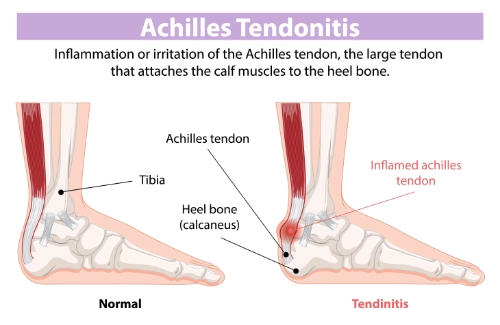
 If every step feels like it starts with a deep, nagging ache in the back of your heel or lower calf, you may be dealing with Achilles tendinopathy. This condition is one of the most common overuse injuries affecting runners, weekend athletes, and even people who simply spend a lot of time on their feet. The good news is that chiropractic care offers a conservative, non-invasive path to recovery that addresses not just the painful tendon itself, but the biomechanical issues throughout the leg, foot, and spine that often contribute to the problem in the first place.
What Is Achilles Tendinopathy
The Achilles tendon is the thick, fibrous band of tissue that connects your calf muscles (the gastrocnemius and soleus) to your heel bone, or calcaneus. It’s the largest and strongest tendon in the body, built to withstand tremendous forces every time you walk, run, or jump. Achilles tendinopathy occurs when this tendon becomes irritated, degenerated, or structurally weakened, typically as a result of repetitive strain that outpaces the tendon’s ability to repair itself.
You may hear this condition referred to by a few different names, including Achilles tendinitis (which technically describes acute inflammation) and Achilles tendinosis (which describes chronic degenerative changes in the tendon fibers). In most long-standing cases, what’s actually happening is tendinosis rather than true inflammation, which is one reason why anti-inflammatory approaches alone often fall short of resolving the problem.
Tendinopathy generally shows up in one of two locations. Midportion Achilles tendinopathy affects the tendon roughly two to six centimeters above the heel bone, while insertional Achilles tendinopathy occurs right where the tendon attaches to the heel. The two types share overlapping symptoms but sometimes respond to slightly different treatment strategies, which is why an accurate assessment matters before starting care.
What Causes Achilles Tendinopathy
Achilles tendinopathy rarely results from a single traumatic event. Instead, it develops gradually from a combination of mechanical stress and underlying biomechanical imbalances. Common contributing factors include:
- A sudden increase in running mileage, speed, or hill training
- Tight or weak calf muscles that place extra strain on the tendon
- Poor foot mechanics, including overpronation or flat feet
- Limited ankle dorsiflexion or restricted joint mobility in the foot and ankle
- Improper or worn-out footwear that fails to support the foot properly
- Muscle imbalances or compensations originating from the hip, knee, or lower back
- Age-related changes in tendon elasticity and blood supply, particularly after age 30
- Training on hard or uneven surfaces without adequate recovery time
One factor that’s frequently overlooked is the role the spine and pelvis play in lower extremity mechanics. When there’s restricted motion or misalignment higher up the kinetic chain, the body compensates by altering gait patterns, which can shift excess load onto the Achilles tendon over time. This is why a thorough evaluation often looks well beyond the ankle itself.
Recognizing the Symptoms
Achilles tendinopathy symptoms typically build gradually rather than appearing all at once. Common signs include:
- A dull, aching pain along the back of the heel or lower calf
- Stiffness and discomfort that’s most noticeable first thing in the morning
- Pain that eases as you warm up, then returns after activity or at rest
- Tenderness or a palpable thickening along the tendon
- Swelling that worsens throughout the day with activity
- A creaking or crackling sensation (crepitus) when moving the ankle
- Reduced strength or a feeling of weakness when pushing off during walking or running
If pain is severe, sudden, and accompanied by an audible pop, this may indicate a partial or complete Achilles tendon rupture rather than tendinopathy, and requires immediate medical evaluation.
How Chiropractic Care Treats Achilles Tendinopathy
Chiropractic treatment for Achilles tendinopathy takes a whole-body approach rather than focusing narrowly on the injured tendon. The goal is to reduce pain, restore proper mechanics, and correct the underlying factors that led to the overload in the first place.
Joint Mobilization and Manipulation
Many patients with Achilles tendinopathy have restricted mobility in the ankle, subtalar joint, or midfoot. Chiropractors use targeted joint mobilization and manipulation techniques to restore normal range of motion, which helps distribute load more evenly through the foot and reduces excess strain on the tendon. Extremity adjustments to the foot and ankle are often paired with an evaluation of the hips, knees, and lower spine, since dysfunction anywhere along this chain can influence how forces travel down to the heel.
Soft Tissue Therapy
Techniques such as myofascial release, active release technique (ART), and instrument-assisted soft tissue mobilization (IASTM, sometimes known as Graston Technique) are commonly used to break up adhesions, improve blood flow, and encourage healthier collagen alignment within the tendon. These hands-on methods can also address tightness in the calf muscles, which directly reduces tension pulling on the Achilles.
Eccentric Loading Exercises
Research consistently supports eccentric strengthening exercises, such as controlled heel drops, as one of the most effective ways to remodel a degenerated tendon and stimulate proper healing. Chiropractors incorporate progressive, individualized eccentric loading protocols into a treatment plan, gradually building tendon capacity so it can tolerate everyday and athletic demands without breaking down again.
Gait and Biomechanical Analysis
Because faulty movement patterns are so often at the root of Achilles problems, a full gait and biomechanical assessment is a key part of chiropractic care. This may reveal issues like overpronation, leg length differences, or hip weakness that are quietly overloading the tendon with every step. Correcting these patterns, sometimes with the help of custom orthotics or footwear recommendations, helps prevent the problem from returning after symptoms improve.
Therapeutic Modalities
Depending on the stage of healing, chiropractors may also use supportive modalities such as therapeutic ultrasound, laser therapy, or kinesiology taping to manage pain, reduce swelling, and support tissue repair alongside manual treatment and rehabilitative exercise.
Chiropractic Care Versus Injections and Surgery
When Achilles pain becomes chronic, some patients are steered toward corticosteroid injections or, in severe cases, surgical intervention. Both carry real drawbacks worth understanding. Corticosteroid injections near the Achilles tendon are generally approached with caution in the medical community, since they’ve been associated with an increased risk of tendon rupture and may only mask pain temporarily without addressing the underlying tendon degeneration or the mechanical issues driving it.
Surgical options, such as debridement of damaged tendon tissue or tendon repair, are typically reserved for cases that fail to respond to months of conservative care. Surgery comes with the inherent risks of any invasive procedure, along with a lengthy recovery and rehabilitation period, often requiring weeks of immobilization followed by months of physical therapy.
Chiropractic care offers a conservative, drug-free alternative that focuses on identifying and correcting the actual mechanical drivers of Achilles tendinopathy rather than simply suppressing the pain signal. For most patients, particularly those caught in the earlier or moderate stages of the condition, this approach can resolve symptoms and restore function without the risks associated with injections or surgery.
What to Expect During Recovery
Achilles tendinopathy tends to heal more slowly than many other soft tissue injuries because tendons have relatively limited blood supply compared to muscle. Most patients can expect a recovery timeline ranging from six to twelve weeks for mild to moderate cases, while more chronic or severe tendinosis may take three to six months of consistent care to fully resolve.
Early in treatment, the focus is typically on reducing pain and inflammation while protecting the tendon from further overload. As symptoms improve, care shifts toward progressive loading, strengthening, and correcting any biomechanical faults uncovered during the initial evaluation. Consistency matters a great deal here. Patients who stick with their prescribed exercises and gradually return to activity, rather than rushing back too soon, have significantly better long-term outcomes and a lower risk of recurrence.
Your chiropractor will typically re-assess progress at regular intervals, adjusting the treatment plan as your tendon’s tolerance for load improves. Many patients are able to return to running and other high-impact activities once strength and flexibility benchmarks are met, often with modifications to training habits or footwear to prevent the issue from coming back.
Don’t Let Achilles Pain Keep You Sidelined
Achilles tendinopathy has a frustrating habit of lingering when it isn’t addressed properly, but you don’t have to accept ongoing heel and calf pain as your new normal. Our chiropractic team can evaluate your foot mechanics, ankle mobility, and overall movement patterns to build a personalized, conservative treatment plan aimed at getting you back to the activities you love. Call our office today to schedule your evaluation and take the first step toward lasting relief.
Frequently Asked Questions
Can a chiropractor really help with Achilles tendon pain?
Yes. Chiropractors are trained to evaluate and treat musculoskeletal conditions throughout the body, including tendon injuries like Achilles tendinopathy. Treatment typically combines joint mobilization, soft tissue therapy, and targeted rehabilitative exercises to reduce pain and restore normal tendon function.
How long does Achilles tendinopathy take to heal?
Recovery time varies depending on severity, but most mild to moderate cases improve within six to twelve weeks of consistent conservative care. Chronic cases involving significant tendon degeneration may take three to six months to fully resolve.
What is the difference between Achilles tendinitis and tendinosis?
Tendinitis refers to acute inflammation of the tendon, while tendinosis describes chronic, degenerative changes in the tendon’s collagen structure without significant active inflammation. Most long-term Achilles pain is actually tendinosis, which explains why anti-inflammatory treatments alone often aren’t enough to resolve it.
Should I stop running if I have Achilles tendinopathy?
You generally don’t need to stop all activity, but high-impact running often needs to be reduced or modified temporarily while the tendon heals. A chiropractor can help determine a safe activity level and guide a gradual return-to-running plan based on your symptoms and progress.
Are cortisone shots a good option for Achilles pain?
Cortisone injections near the Achilles tendon are generally used cautiously because they’ve been linked to an increased risk of tendon rupture. Many patients find that conservative approaches like chiropractic care and progressive loading exercises address the underlying issue more effectively and with fewer risks.
Can flat feet or overpronation cause Achilles tendinopathy?
Yes. Overpronation and flat feet alter the angle at which the Achilles tendon pulls on the heel bone, increasing mechanical stress with every step. Correcting these foot mechanics, sometimes with custom orthotics, is often an important part of both treating and preventing Achilles tendinopathy.
What exercises help with Achilles tendinopathy?
Eccentric strengthening exercises, such as controlled heel drops off a step, are among the most well-supported exercises for remodeling a damaged Achilles tendon. A chiropractor can guide you through a progressive loading program tailored to your specific stage of healing.

